
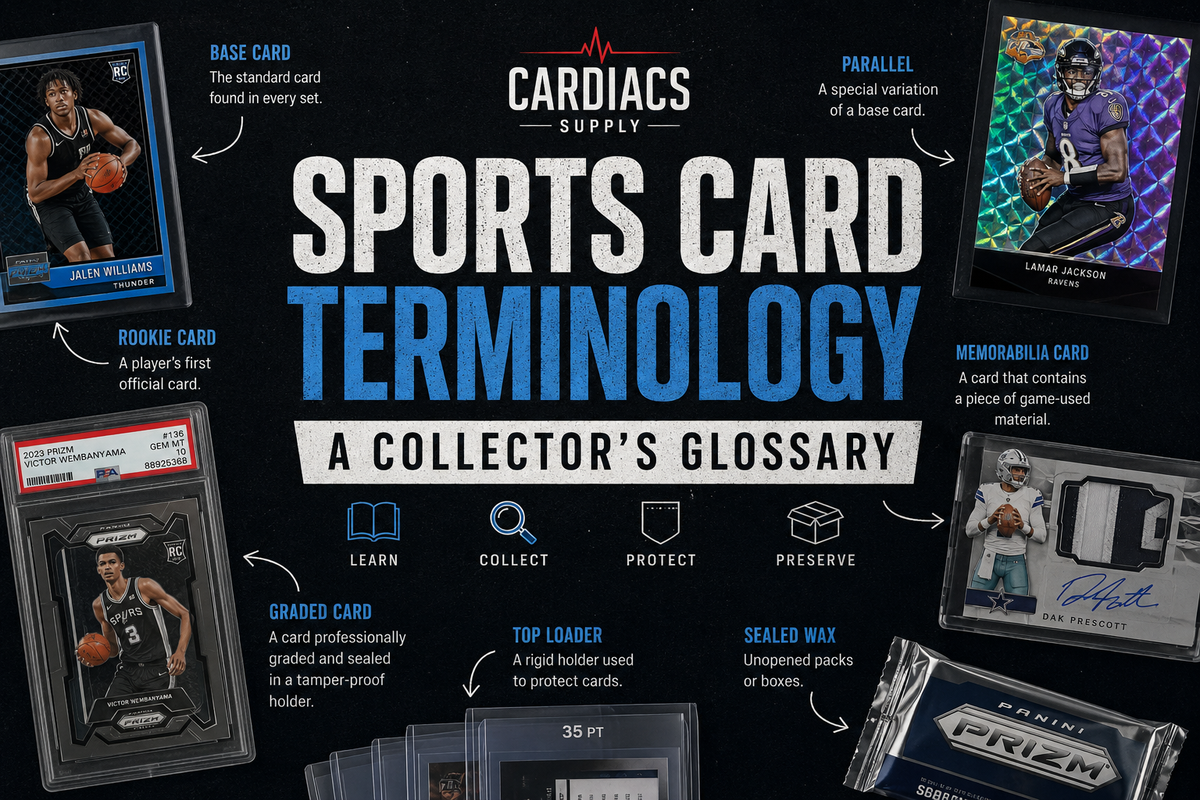
If you’re new to collecting sports cards, sometimes it can feel like everyone is speaking another language. This glossary covers some of the most common terms you’ll encounter when buying, selling, trading, or opening sports cards. Bookmark it. You’ll probably be back.
Base Card : The standard version of a card included in the main set. Other versions of the same card, such as different colors or numbered versions, may be parallels of the base card.
Base Set: The primary checklist of cards making up a trading card release.
Blaster Box: A retail-format box containing multiple packs of cards. Blasters may feature retail- or blaster-exclusive parallels and inserts.
Learn more in Blaster Boxes vs. Hobby Boxes.
Bowman 1st: A designation commonly associated with a player’s first Bowman prospect card. A Bowman 1st is not necessarily the same thing as a player’s traditional rookie card.
Break: An event where sealed trading card products are opened and the cards are distributed to participants according to predetermined rules. Common formats include team breaks, player breaks, and division breaks. Always understand the rules and allocation method before joining a break.
Breaker: A person or business conducting a card break.
Case: A factory-shipped quantity containing multiple boxes of the same trading card product. The number of boxes in a case varies by product.
Case Hit: A hobby term generally used for an especially difficult-to-pull insert or card associated with approximately case-level rarity. However, the phrase is sometimes used casually. Unless the manufacturer provides specific odds, don’t assume that “case hit” literally guarantees exactly one copy per case.
Checklist :The complete list of cards available within a particular trading card product or set. A checklist may include: Base cards, Rookies, Inserts, Parallels, Autographs, Memorabilia cards. Checking the checklist before buying wax can tell you whether the players or cards you’re chasing are actually available.
Chrome: A term commonly associated with cards featuring a shiny chromium-style finish. Chrome cards may also have various refractor-style parallels.
Common: Traditionally, a card produced in larger quantities or considered easier to obtain. The term may also be used casually for lower-value cards.
Factory Set: A complete card set packaged and sealed by the manufacturer rather than assembled card-by-card from packs.
Fat Pack: A retail pack generally containing more cards than a standard pack. Sometimes also called a value pack, depending on the manufacturer and product.
Graded Card: A card that has been evaluated by a professional third-party grading company and encapsulated in a protective holder. Grades generally evaluate factors such as: Centering, Corners, Edges, Surface. Exact grading standards vary by company.
Hit: A general hobby term for a desirable pull. Depending on the product or collector, this might refer to: Autographs, Memorabilia cards, Low-numbered parallels, Rare inserts, Other chase cards. Because “hit” can be used loosely, check the actual product description rather than assuming exactly what the term means.
Hobby Box: A sealed trading card box configured for hobby distribution. Depending on the release, hobby boxes may contain hobby-exclusive parallels, inserts, autographs, memorabilia, or guaranteed hits.
See Blaster Boxes vs. Hobby Boxes for more information.
Insert: A card belonging to a subset separate from the primary base set. Inserts often have different designs, themes, or rarity levels.
Jersey Card: A memorabilia card containing a piece of material represented as coming from a jersey or uniform. Always read the language printed on the card or provided by the manufacturer to understand how the memorabilia is characterized.
Junk Wax Era: A hobby term generally associated with a period of extremely high sports card production, particularly around the late 1980s and early 1990s. Many cards from this period remain widely available because of the enormous quantities produced.
Mega Box: A larger retail-format trading card product that may contain additional packs, cards, or exclusive content.
See our guide: What Is a Mega Box?
Memorabilia Card: A trading card containing an embedded piece of material. Depending on the card, that might include material represented as coming from: Jerseys, Uniforms, Equipment, Other memorabilia. The relationship between the material and a specific player, game, or event varies. Read the manufacturer’s language on the individual card.
Numbered Card / Serial-Numbered Card: A card displaying a stated print quantity. For example: 24/99 indicates that the card is numbered 24 out of a stated run of 99 copies of that version. Collectors commonly shorten this to: #’d /99.
One-of-One / 1-of-1 / 1/1: A card identified as having only one copy of that particular version. You’ll often see collectors write this as 1/1.
One-Touch: A common hobby term for a rigid magnetic card holder. Magnetic holders come in multiple thicknesses.
See our Magnetic Holder Size Guide before choosing one.
Pack: A sealed package containing trading cards. Multiple packs are typically contained inside retail and hobby boxes.
Parallel: An alternate version of another card, usually sharing the same basic subject and design but featuring a different color, foil treatment, pattern, finish, or numbering. A base card might have numerous parallels of varying rarity.
Patch Card: A type of memorabilia card containing a thicker or more distinctive piece of material, often associated with a patch, logo, lettering, or other portion of a uniform. Patch cards can be significantly thicker than standard cards and may require specialized sleeves and holders.
Penny Sleeve: A thin, flexible plastic sleeve used as a basic layer of card protection. Despite the name, they don’t necessarily cost a penny. For most raw cards requiring additional protection, the penny sleeve is the first layer before inserting the card into another appropriate holder.
Pop / Population: The number of examples of a particular card and grade recorded in a grading company’s population report. For example, “Pop 20” generally means the grading company’s report lists 20 examples at that particular grade. Population numbers can change as additional cards are graded.
PSA 10: A card receiving a Gem Mint 10 grade from PSA. Different grading companies have their own grading scales and standards, so a numerical grade should always be considered in the context of the company that assigned it.
Raw Card: A card that has not been encapsulated and graded by a professional grading company. A raw card may still be stored in a sleeve, top loader, semi-rigid, or magnetic holder.
Refractor: A term associated with certain chromium-finish cards featuring a reflective optical effect. Different products may use different terminology for similar-looking parallel treatments.
Relic: Another commonly used term for a memorabilia card containing an embedded piece of material.
Retail: Trading card products configured for retail distribution. Common retail formats include: Blaster boxes, Mega boxes, Hangers, Value packs, Retail packs.
Rip: To open a sealed trading card pack, box, or other product.
If you’re debating whether to open yours, see Rip or Hold?
Rookie Card / RC: A card recognized as part of a player’s official rookie-year card offerings. You’ll commonly see "RC" used as shorthand for rookie card. Rookie-card designation can become complicated depending on the sport, league, manufacturer, and product.
Semi-Rigid: A flexible card holder that provides more structure than a penny sleeve but less rigidity than a top loader. Semi-rigids are commonly used when submitting cards for professional grading.
See When to Use Semi-Rigid Card Holders.
Sealed Wax: Hobby terminology for unopened trading card products still in their original manufacturer packaging. Despite the name, modern products aren’t necessarily packaged in wax paper.
Read our Complete Guide to Sealed Wax for more.
Short Print / SP: A card produced or inserted less frequently than standard cards in a set. Collectors commonly abbreviate short print as "SP".
SSP: Common shorthand for Super Short Print, generally indicating a card considered even more difficult to pull than a typical short print. Terminology and actual rarity vary by product.
Single: An individual card purchased separately rather than pulled from a sealed product. If you want one particular card, buying the single is often the most direct way to add it to your collection.
Slab: Collector slang for the sealed plastic holder containing a professionally graded card.
Top Loader: A rigid plastic holder commonly used to protect individual trading cards. Cards are generally placed in an appropriate sleeve before being inserted into a top loader. Top loaders are available in multiple thicknesses for standard and oversized cards.
See our Top Loader Size Guide to choose the correct size.
Variation: An alternate version of a card that differs from the standard version. Variations may feature a different photograph, design element, image, or other characteristic.
Wax: Collector shorthand for unopened trading card products.
See Sealed Wax.
Wax Box: A general term for a sealed box of trading cards. Depending on context, it could refer to hobby or retail products.
Why Learning Card Terminology Matters
You don’t have to memorize the entire hobby dictionary before you start collecting.
But understanding the terminology makes it much easier to:
- Read product descriptions
- Understand checklists
- Compare sealed products
- Choose card supplies
- Evaluate listings
- Talk with other collectors
- Know what you’re actually buying
And if you encounter a term you don’t recognize? Come back here. We’ll keep adding to this glossary as the hobby changes.