
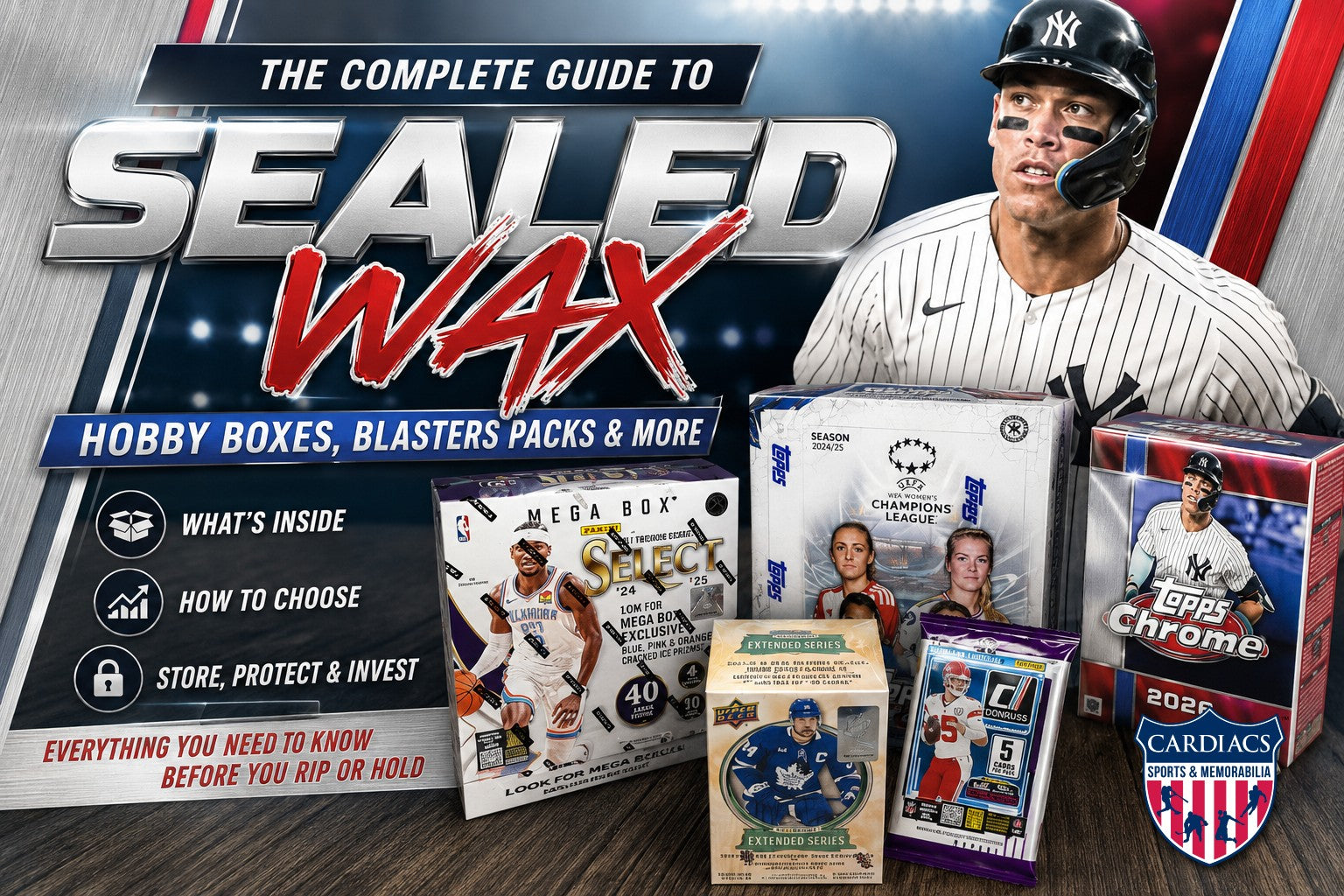
If you’re new to sports cards, one of the first hobby terms you’ll hear is sealed wax. Despite the name, nobody is necessarily talking about wax.
In the trading card hobby, “wax” is a long-standing nickname for unopened trading card products. Today, collectors use the term broadly for sealed packs, boxes, and other unopened card products.
But not all sealed wax is the same. Hobby boxes, retail blasters, mega boxes, hangers, fat packs, hobby packs, retail packs, and premium products can contain very different configurations and potential hits.
Here’s what you need to know before choosing what to rip or what to keep sealed.
What Is Sealed Wax?
Sealed wax is an unopened trading card product that remains in its original manufacturer packaging.
Depending on the product, that could include:
- Individual card packs
- Hobby boxes
- Blaster boxes
- Mega boxes
- Hanger boxes
- Value or fat packs
- Complete factory sets
- Premium boxes
- Other factory-sealed trading card products
Once the original packaging has been opened, it’s no longer considered sealed wax.
Why Is It Called “Wax”?
The term comes from earlier generations of trading cards when packs were commonly wrapped in wax-coated paper. Collectors began referring to unopened packs and boxes as “wax,” and the terminology stuck. Modern trading cards may come in foil packs, plastic wrapping, cardboard boxes, metal tins, and other packaging, but collectors still use “wax” as shorthand for unopened product.
Hobby vs. Retail: What’s the Difference?
One of the most important distinctions in sealed wax is hobby versus retail.
Hobby Products
Hobby products are generally distributed through hobby shops and authorized dealers.
Depending on the release, hobby configurations may offer:
- Exclusive parallels
- Hobby-exclusive inserts
- Different autograph or memorabilia odds
- Guaranteed hits
- Larger pack or card counts
- Different product configurations
Exactly what is included varies by release. Never assume that every hobby box guarantees an autograph or memorabilia card. Always check the manufacturer’s product information for the specific release.
Retail Products
Retail configurations are products traditionally distributed through mass-market retailers.
Common formats include:
- Blaster boxes
- Mega boxes
- Hanger boxes
- Value packs
- Retail packs
Retail products can have their own exclusive parallels and inserts that aren’t available in hobby configurations. That means retail isn’t simply a “lesser” version of hobby wax. Depending on what you’re chasing, a retail-exclusive parallel may be exactly what you want.
What Is a Hobby Box?
A hobby box is a sealed box specifically configured for hobby distribution. The exact contents vary dramatically between products. One hobby box might guarantee an autograph. Another might guarantee multiple autographs or memorabilia cards. Another may not guarantee a traditional “hit” at all.
When evaluating a hobby box, look at:
- Packs per box
- Cards per pack
- Guaranteed hits
- Possible autographs
- Memorabilia cards
- Parallel structure
- Hobby-exclusive cards
- Insert sets
- Manufacturer odds
The product configuration matters more than the words “hobby box” alone.
What Is a Blaster Box?
A blaster box is one of the most recognizable retail trading card formats. Blasters usually contain several sealed packs inside a small box and are designed as an accessible way to open a particular release.
Depending on the product, blasters may contain exclusive parallels or inserts. A blaster may have fewer cards or different hit odds than a hobby box, but that doesn’t mean every blaster configuration is identical. Always compare the specific release.
What Is a Mega Box?
A mega box is generally a larger retail configuration than a blaster.
Mega boxes may contain:
- More packs
- More cards
- Exclusive parallels
- Exclusive inserts
- Different configurations
Again, “mega” describes the product format, not a universal set of contents. Two mega boxes from different trading card releases can be completely different products.
What Is a Hanger Box?
A hanger is another retail format that typically contains cards in a compact package designed to hang on a retail display. Some releases have developed strong collector followings specifically because certain hanger configurations contain desirable exclusive parallels or favorable product configurations. Never judge a sealed product solely by the size of the box.
What Are Fat Packs and Value Packs?
Fat packs and value packs typically contain more cards than a standard individual retail pack. They can be an affordable way to open more cards from a set without purchasing an entire box. Some releases also include parallels or inserts exclusive to these formats.
What Does “Guaranteed Hit” Mean?
In sports cards, a hit generally refers to a more desirable pull such as:
- An autograph
- Memorabilia or relic card
- Premium insert
- Low-numbered parallel
- Other chase card
But the term can be used somewhat loosely by collectors. More importantly, if a manufacturer says a product contains a certain number of autographs or memorabilia cards on average, that is not necessarily the same thing as a guarantee. Read the manufacturer’s wording carefully.
What Is a Parallel?
A parallel is an alternate version of a card from the same basic set.
Parallels may differ through:
- Color
- Foil
- Pattern
- Refractor effect
- Serial numbering
- Print quantity
- Retail or hobby exclusivity
For example, the same player’s base card might also exist as several colored parallels, some of which are much harder to pull. Understanding a product’s parallel structure is an important part of understanding sealed wax.
What Does Serial Numbered Mean?
A serial-numbered card has a stated print quantity represented directly on the card.
For example:
37/99
means that particular card is numbered 37 out of a stated print run of 99 copies for that version.
You may also see cards numbered:
/499
/199
/99
/50
/25
/10
/5
/1
Generally, lower-numbered parallels are harder to pull, although scarcity alone doesn’t determine a card’s market value.
What Is a Case Hit?
A case hit is a term used for especially difficult-to-pull inserts or cards associated with approximately case-level rarity. But collectors should be careful with this terminology. “Case hit” is sometimes used casually even when a manufacturer hasn’t officially described a card that way. Depending on the product, a card may fall more or less frequently than exactly one per case. Treat “case hit” as a description of rarity unless official product information provides specific odds.
What Does “Chasing” a Card Mean?
Collectors often buy sealed wax because they’re chasing a particular card, player, insert, autograph, or parallel.
For example, someone might be chasing:
- A rookie card
- A favorite player
- A specific autograph
- A numbered parallel
- A short-print insert
- A case-hit insert
That’s part of what makes opening sealed wax fun: you don’t know exactly what’s inside.
It also introduces an important distinction.
Buying Wax vs. Buying Singles
If you want one specific card, buying that card individually is often the more direct approach. If you enjoy opening packs, collecting a set, discovering unexpected cards, or chasing rare pulls, sealed wax offers an entirely different experience. Neither approach is inherently better. They’re simply different ways to collect.
- Buy singles when you primarily want a particular card.
- Buy sealed wax when the opening experience and possibility of different pulls are part of what you enjoy.
Should You Rip It or Keep It Sealed?
This might be the most debated question in the hobby. Some collectors purchase sealed products specifically to open them. Others maintain sealed wax collections.
Keeping a product sealed preserves the unopened product itself, but it does not guarantee that the product will increase in value.
- Trading card markets change.
- Player performance changes.
- Collector demand changes.
Products that are highly desirable today may become less desirable later—and occasionally the opposite happens. If you’re collecting sealed wax, treat future value as a possibility rather than a promise.
How Should You Store Sealed Wax?
Sealed trading card products should be protected from the same environmental threats that affect individual cards.
Keep sealed products away from:
- Excessive heat
- High humidity
- Water
- Direct sunlight
- Large temperature swings
- Crushing or excessive weight
- Areas prone to pests
A climate-controlled indoor environment is generally preferable to garages, attics, sheds, or damp basements. Also avoid stacking heavy boxes in ways that can crush packaging. For collectors, the condition of the sealed box itself can matter.
Does Damaged Shrink Wrap Matter?
It can. If you’re buying a product specifically as a sealed collectible, the condition of the original packaging becomes part of the product’s appeal. Torn shrink wrap, crushed corners, damaged boxes, or questionable seals can make buyers more cautious. That’s particularly important with older or higher-value wax.
What Should You Look at Before Buying Sealed Wax?
Before choosing a product, ask yourself what you actually want from it.
-
If you want autographs:
- Check the autograph checklist and product configuration.
-
If you’re chasing a specific rookie:
- Make sure the player is actually included in that product and understand which cards or parallels you’re chasing.
-
If you want memorabilia:
- Check whether memorabilia cards are included and whether they’re guaranteed or simply possible pulls.
-
If you’re chasing parallels:
- Compare hobby and retail exclusives before deciding which configuration to buy.
-
If you’re collecting sealed products:
- Consider the release, checklist, rookie class, product reputation, scarcity, and condition of the sealed box.
Don’t Forget the Supplies Before You Rip
There’s nothing worse than pulling a great card and realizing you don’t have the right supplies to protect it.
Before opening wax, it’s smart to have:
- Penny sleeves
- Standard top loaders
- Thick-card sleeves
- Several sizes of thick top loaders or magnetic holders
This becomes especially important when opening products containing memorabilia cards or other thick cards. If you pull something thicker than a standard card, don’t force it into a standard holder.
Use our Top Loader Size Guide or Magnetic Holder Size Guide to determine what you need.
Final Thoughts
“Sealed wax” is hobby terminology for unopened trading card products in their original manufacturer packaging. It can include hobby boxes, blasters, mega boxes, hangers, packs, factory sets, and other sealed products. Different configurations may contain different parallels, inserts, autographs, memorabilia cards, and odds, so always check the specific product before buying.