
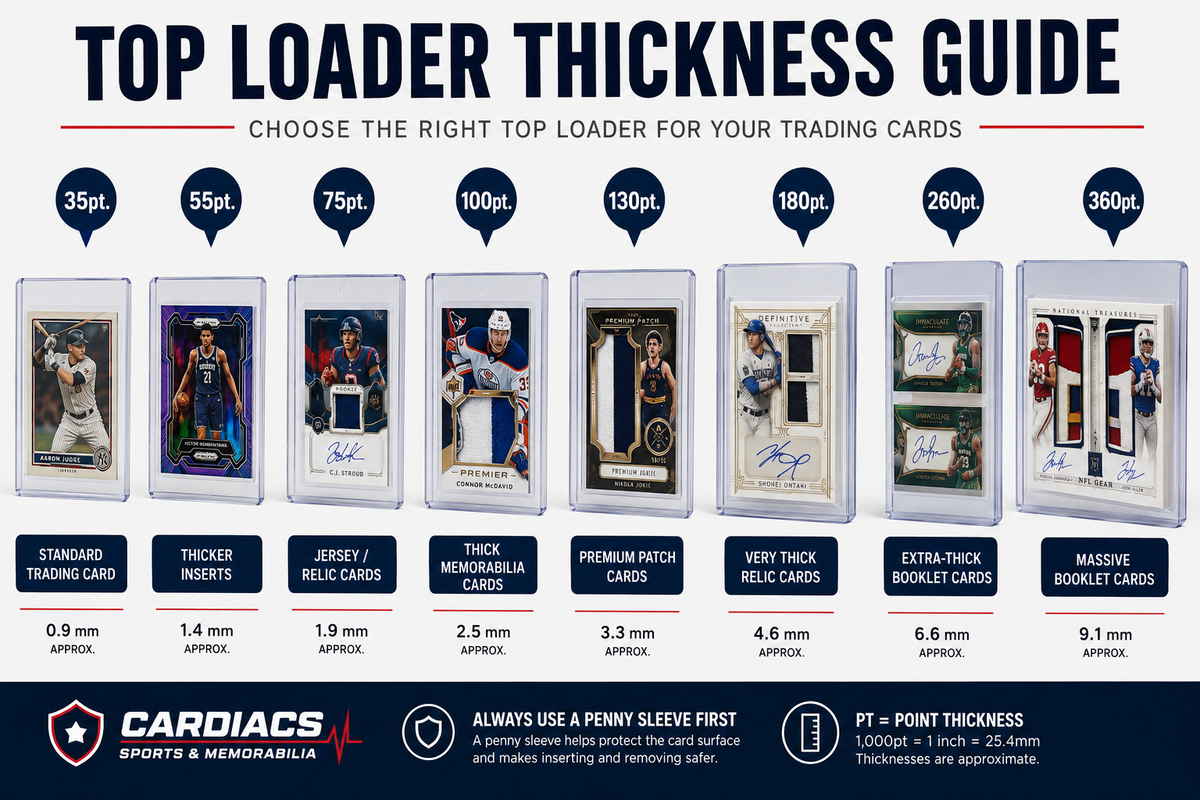
If you've ever wondered what size top loader your trading card needs, you're not alone. One of the most common questions collectors ask is whether they should use a 35pt, 55pt, 75pt, or thicker top loader.
Choosing the correct size helps protect your cards from damage while ensuring they fit comfortably without excessive movement or pressure.
This guide explains the most common top loader sizes and when each should be used.
What Does “PT” Mean?
Top loader thickness is measured in points (pt). The larger the point value, the thicker the card the holder is designed to accommodate. Most standard trading cards fit into a 35pt top loader, while memorabilia cards, jersey cards, patch cards, and booklets often require larger sizes.
35pt Top Loaders
Best for:
● Standard sports cards
● Pokémon
● Magic: The Gathering
● One Piece
● Yu-Gi-Oh
● Most modern trading cards
A 35pt top loader is by far the most used size. If you're collecting standard cards from packs, this is likely the holder you'll use most often.
55pt Top Loaders
Best for:
● Slightly thicker inserts
● Chrome cards with additional thickness
● Some premium parallels
These cards are just a bit thicker than standard cards but don't require oversized holders.
75pt Top Loaders
Best for:
● Jersey cards
● Memorabilia cards
● Thick inserts
Many relic cards fit comfortably in a 75pt holder. Always verify the card thickness before choosing a holder.
100pt Top Loaders
Best for:
● Thick memorabilia cards
● Multi-color patch cards
● Premium inserts
These holders provide additional room for cards with significantly more thickness.
130pt Top Loaders
Best for:
● Large memorabilia cards
● Thick game-used patch cards
Many high-end products include cards that fit into 130pt holders.
180pt Top Loaders
Best for:
● Very thick memorabilia cards
● Multi-piece relic cards
These holders are intended for cards that are considerably thicker than standard issues.
260pt Top Loaders
Best for:
● Booklet cards
● Extra-thick premium memorabilia cards
Not every collection requires this size, but it's essential for certain specialty cards.
360pt Top Loaders
Best for:
● Massive booklet cards
● Cards with embedded objects or extreme multi-piece construction
This is the upper limit of standard top loader sizing, reserved for true outlier cards that won't fit in anything smaller.
Should You Use a Penny Sleeve First?
Yes, before inserting a card into any top loader, place it inside a penny sleeve. The sleeve helps protect the card's surface from scratches that can occur while sliding it into or out of the holder. Click here to learn more about penny sleeves.
If you need sleeves, browse our selection of penny sleeves designed to pair with our top loaders.
How Can I Tell What Size My Card Needs?
The easiest method is to compare your card with others you already own. If you're unsure, many manufacturers publish thickness information for memorabilia cards. You can also use a card thickness gauge, which measures the approximate point size of your card before selecting a holder. When in doubt, avoid forcing a card into a holder that's too small.
Common Mistakes
Avoid these common errors:
● Using a standard 35pt holder for thick memorabilia cards.
● Forcing a thick card into a top loader.
● Skipping the penny sleeve.
● Using holders that are much larger than necessary.
● Assuming every relic card uses the same thickness.
A properly fitted top loader offers the best protection.
Frequently Asked Questions
What size top loader fits most trading cards?
Most standard trading cards fit into a 35pt top loader.
Should I use a penny sleeve with a top loader?
Yes, a penny sleeve helps protect the card's surface and makes inserting and removing the card safer.
Are all jersey cards the same thickness?
No, jersey and memorabilia cards vary widely in thickness depending on the manufacturer and the amount of material used.
Can a top loader damage a card?
Only if the holder is too small or the card is forced into it. Always choose the correct size for your card.
What's the difference between a top loader and a magnetic holder?
Top loaders are lightweight, inexpensive, and commonly used for storage. Magnetic holders offer a more premium display option and are often used for showcase cards.
Quick Reference Guide
|
Top Loader Size |
Opening/Width (mm) |
Common Uses |
|
35pt |
~0.9 mm |
Standard Trading Card |
|
55pt |
~1.4 mm |
Slightly Thicker Inserts |
|
75pt |
~1.9 mm |
Jersey Cards |
|
100pt |
~2.5 mm |
Thick Memorabilia Cards |
|
130pt |
~3.3 mm |
Premium Patch Cards |
|
180pt |
~4.6 mm |
Very Thick Relic Cards |
|
260pt |
~6.6 mm |
Extra-thick Relic and Multi-Card Pieces |
|
360pt |
~9.1 mm |
Massive Booklet Cards |
mm values are approximate (1,000pt = 1 inch = 25.4mm) and rounded for reference — always verify actual card thickness before selecting a holder.
Final Thoughts
Choosing the correct top loader is one of the easiest ways to protect your trading cards. A holder that's too small can put unnecessary pressure on the card, while one that's too large allows it to move around more than it should.
When paired with a quality penny sleeve, the right top loader helps keep your cards protected whether you're storing them, displaying them, or preparing them for grading.