
If you collect trading cards, you’re probably familiar with penny sleeves and top loaders. But there’s another type of card holder you’ll see frequently in the hobby: the semi-rigid card holder.
Semi-rigid holders are especially common when cards are being submitted for professional grading, but that isn’t their only use. Knowing when to use a semi-rigid holder versus another type of protection can help you safeguard your collection without overcomplicating your storage system.
What Is a Semi-Rigid Card Holder?
A semi-rigid card holder is a thin plastic card protector that is firmer than a penny sleeve but more flexible than a traditional top loader. The card is first placed inside a penny sleeve and then carefully inserted into the semi-rigid holder. Unlike a top loader, which has a relatively rigid plastic shell, a semi-rigid holds the sleeved card more securely in place while still allowing some flexibility.
When Should You Use a Semi-Rigid Card Holder?
- When Submitting Cards for Grading
This is the most common reason collectors use semi-rigid holders. Many professional grading companies prefer or recommend that cards be submitted in semi-rigid holders because they make it easier for grading staff to safely remove the card.
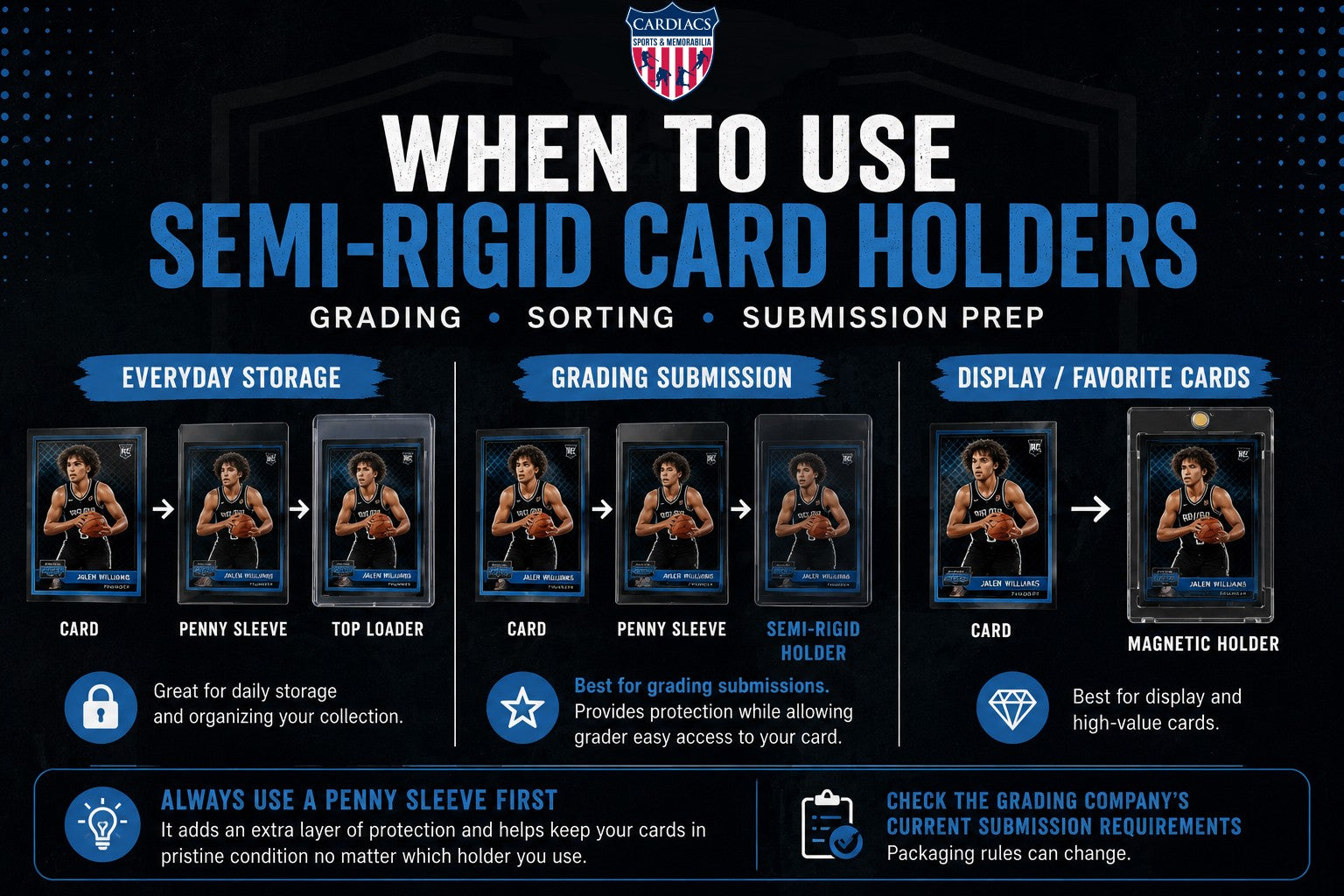
A typical grading submission setup is:
Card → Penny Sleeve → Semi-Rigid Holder
Before submitting cards, always check the current packaging requirements of the grading company you are using. Requirements can change, and some grading services have specific preferences for how cards should be packaged.
2. When Preparing Cards for Evaluation or Submission
Even if you haven’t decided whether a card will ultimately be graded, semi-rigids can be useful for organizing potential grading candidates.
For example, you might separate cards into groups such as:
-
- Cards ready for submission
- Cards needing further inspection
- Cards being evaluated for grading
- Cards waiting for a future grading
Because semi-rigids are thinner than many hard plastic holders, they can also make it easier to organize larger groups of cards awaiting submission.
3. When You Want a Slim Protective Holder
Semi-rigid holders provide more structure than a penny sleeve without adding as much bulk as a traditional top loader. That can make them useful when temporary protection is needed during sorting, evaluation, or preparation. However, semi-rigids are generally not our first choice for long-term display protection. For cards you frequently handle, display, sell individually, or store as part of a permanent collection, another holder may be more appropriate.
Semi-Rigid vs. Top Loader
Both protect trading cards, but they’re designed for somewhat different jobs.
Semi-rigid holders are best for:
- Grading submissions
- Organizing grading candidates
- Temporary card protection
- Situations where a thinner holder is useful
Top loaders are best for:
- General card storage
- Individual card protection
- Cards that are handled regularly
- Cards being organized in storage boxes
- Shipping when properly packaged
If you’re building a general card protection system rather than preparing a grading submission, start with our Top Loader Size Guide to determine which holder best fits your card.
Semi-Rigid vs. Magnetic Holder
Magnetic card holders, often called one-touch holders, serve a different purpose. A magnetic holder provides a more substantial rigid enclosure and is commonly used for valuable cards, display pieces, autographs, memorabilia cards, and cards collectors want to showcase. Semi-rigids prioritize easy card access and a slim profile. Magnetic holders prioritize protection and presentation. If you’re protecting a card you plan to display rather than submit for grading, see our Magnetic Holder Size Guide.
Do You Still Need a Penny Sleeve?
Yes, a card should generally be placed in a penny sleeve before being inserted into a semi-rigid holder. The sleeve provides an additional barrier between the card’s surface and the holder. This is especially important for cards with sensitive surfaces, including modern chrome and foil cards.
Are Semi-Rigids Good for Long-Term Storage?
They can protect cards during storage, but they aren’t necessarily the best holder for every collection. For most collectors, it makes more sense to choose protection based on what you’re doing with the card:
Everyday collection storage: Penny sleeve + appropriately sized top loader (Click here to learn more about top loader sizes)
Grading submission: Penny sleeve + semi-rigid holder
Display or higher-value cards: Properly sized magnetic holder. There isn’t one card holder that’s best for every situation.
Final Thoughts
Semi-rigid card holders have a very specific strength: they provide more support than a sleeve while remaining thin, flexible, and easy to work with. They’re particularly useful when preparing cards for professional grading.
For most collections, think of card protection as a system rather than a single product. The right sleeve, holder, and storage method depends on the card’s thickness, value, and what you plan to do with it.