
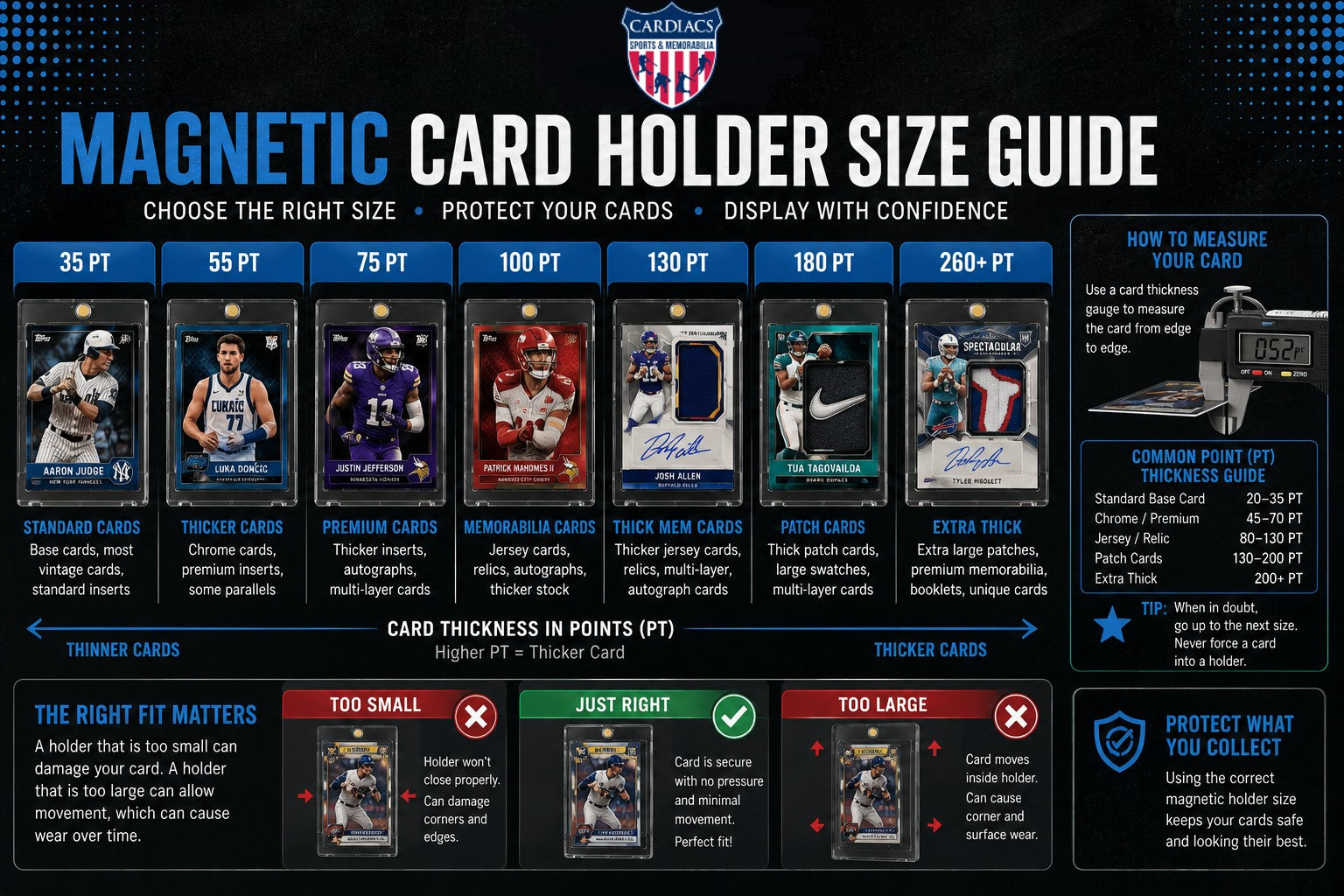
Magnetic card holders, often called one-touch holders, are one of the easiest ways to protect and display individual trading cards.
But there’s one important catch: You need the right size. A standard trading card, chrome card, jersey card, patch card, and thick memorabilia card can all require different magnetic holder thicknesses. Using a holder that’s too small can put pressure on the card. Using one that’s too large allows unnecessary movement inside the holder.
Here’s how to choose the right magnetic holder.
What Does “PT” Mean on a Magnetic Card Holder?
Magnetic holders are commonly sized in points, abbreviated PT. Point size refers to the approximate thickness of the card the holder is designed to accommodate. The higher the PT number, the thicker the card.
For example:
|
Holder Size |
Common Uses |
|
35 PT |
Standard trading cards |
|
55 PT |
Slightly thicker cards and some premium/chrome cards |
|
75 PT |
Thicker premium cards |
|
100 PT |
Memorabilia and jersey cards |
|
130 PT |
Many thicker relic, jersey and autograph cards |
|
180 PT |
Thick patch and memorabilia cards |
|
260 PT+ |
Extra-thick premium memorabilia cards |
These are general guidelines. Card construction varies considerably between manufacturers and products, so actual card thickness should determine holder size whenever possible.
35 PT Magnetic Holders
A 35 PT magnetic holder is the standard starting point for traditional trading cards.
It commonly fits standard-thickness:
- Baseball cards
- Football cards
- Basketball cards
- Hockey cards
- Soccer cards
- Non-sports trading cards
If the card feels like a typical base card, 35 PT is usually the first size to check.
55 PT and 75 PT Magnetic Holders
Some premium cards are thicker than standard base cards without being true memorabilia cards. This is where 55 PT and 75 PT holders become useful.
Cards in this range may include certain:
- Chrome-style cards
- Premium inserts
- Autograph cards
- Multi-layer cards
- Specialty parallels
Don’t assume that every chrome card requires a larger holder, however. Product construction varies. When in doubt, measure the card.
100 PT and 130 PT Magnetic Holders
Once you start collecting memorabilia cards, card thickness becomes much more variable. 100 PT and 130 PT magnetic holders are commonly used for cards containing materials such as:
- Jersey swatches
- Relics
- Autographs with thicker card stock
- Multi-layer designs
- Premium memorabilia
A 130 PT magnetic holder is one of the more common sizes collectors encounter when protecting modern memorabilia cards. But “jersey card” does not automatically mean 130 PT. Some are thinner and some are considerably thicker.
180 PT Magnetic Holders
Thick patches, multi-layer memorabilia cards, and premium releases can require a 180 PT holder. These cards are noticeably thicker than standard cards and should never be forced into a smaller magnetic holder. If the holder doesn’t close naturally, stop. The holder is too small.
260 PT and Extra-Thick Magnetic Holders
Some modern premium products contain exceptionally thick cards. Large patches, specialty memorabilia, booklets, and unusual card constructions may require 260 PT or another specialty holder. At this point, measuring the card before selecting a holder becomes particularly important.
How to Measure Your Card
The safest way to choose a holder is to determine the actual thickness of your card.
A card thickness gauge makes this easy. Many gauges allow you to compare the edge of the card with common PT measurements. If your card falls between two sizes, avoid squeezing it into the smaller holder. A magnetic holder should close normally without putting pressure on the card.
Signs Your Magnetic Holder Is Too Small
Never force a card into a magnetic holder.
Watch for:
- The holder not closing completely
- Pressure on the card’s surface
- Pinching around the edges
- The card sitting above the recessed area
- Resistance when closing the holder
If you notice any of these, move to a larger holder.
Signs Your Magnetic Holder Is Too Large
Going too large isn’t ideal either. A card with excessive room can shift inside the holder. Movement may allow the card’s corners or edges to contact the interior of the case. The goal is simple: Secure fit without pressure.
Should You Put a Penny Sleeve Inside a Magnetic Holder?
This depends on the holder.
Traditional magnetic holders are typically designed for the card to sit directly inside a recessed cavity. Adding a standard penny sleeve to a holder that wasn’t designed for one can interfere with proper fit and closure.
However, some magnetic holders are specifically designed to accommodate a sleeved card. Always use the holder according to its design. If you specifically want your card sleeved inside the magnetic case, choose a sleeve-compatible magnetic holder rather than forcing a sleeve into a standard one-touch.
Magnetic Holder vs. Top Loader
Choose based on what you want the holder to do.
Choose a top loader when:
- Storing larger quantities of cards
- Organizing cards in storage boxes
- Protecting everyday collection cards
- You want economical protection
Choose a magnetic holder when:
- Displaying a favorite card
- Protecting a higher-value individual card
- Storing an autograph or memorabilia card
- You want protection and presentation in one holder
For everyday card storage, see our Top Loader Size Guide.
Quick Magnetic Holder Size Reference
Standard base card: Start around 35 PT
Slightly thicker/premium card: Check 55–75 PT
Jersey or memorabilia card: Check 100–130 PT
Thick patch card: Check around 180 PT
Extra-thick premium card: Check 260 PT, 360 PT or specialty sizes
These are starting points, not guarantees. Measure the card whenever possible.
The Bottom Line
The best magnetic holder isn’t the thickest one you can find. It’s the one that properly fits your card. Your card should sit securely in the recessed area without being squeezed and without excessive movement. When you’re unsure, measure first.
A few seconds spent checking card thickness is much better than discovering that your favorite card doesn’t fit after you’ve already tried to close the holder.